The “Fifth Wall” Is Ready for Its Close-Up
For years, ceilings were treated as little more than blank space: white paint, maybe a light fixture, and not much else.
That is changing.
Designers are increasingly treating the ceiling as a “fifth wall”—another surface that can carry color, texture, pattern and personality. Houzz has specifically identified wallpapered ceilings as part of the recent wallpaper revival, noting that designers are using wallpaper, rich paint colors, beams and coffers to bring character to a surface that was traditionally ignored.
And once you begin looking at a ceiling that way, the possibilities become surprisingly expansive.
Bringing the room full circle
What I love most about a ceiling treatment is the sense of immersion it can create.
A room doesn’t have to stop at eye level. A patterned ceiling can visually complete the space, drawing the eye upward and creating a more enveloping environment. Houzz has explored this idea for years, describing ceiling wallpaper as a way to transform the mood of a room, improve proportions, and introduce pattern where walls may already be occupied by windows, cabinetry or architectural details.
That becomes especially interesting in coastal interiors.
So much of coastal design is already about maintaining a relationship with the landscape outside: water, grasses, flowers, birds, dunes, marshes and changing light. When a room has large windows or doors opening onto a garden, marsh or coastal view, a botanical or wildlife-inspired ceiling can extend that connection inward.
Rather than simply hanging a picture of nature on a wall, the room begins to feel surrounded by it.
A different kind of coastal design
Coastal interiors can easily fall into familiar shorthand—blue-and-white stripes, anchors, shells and obvious beach motifs.
There is nothing wrong with those things. But there are subtler ways to evoke a place.
A ceiling patterned with milkweed, beach plum, marsh grasses, birds or native botanicals can reference the coast through its ecology rather than through traditional nautical decoration.
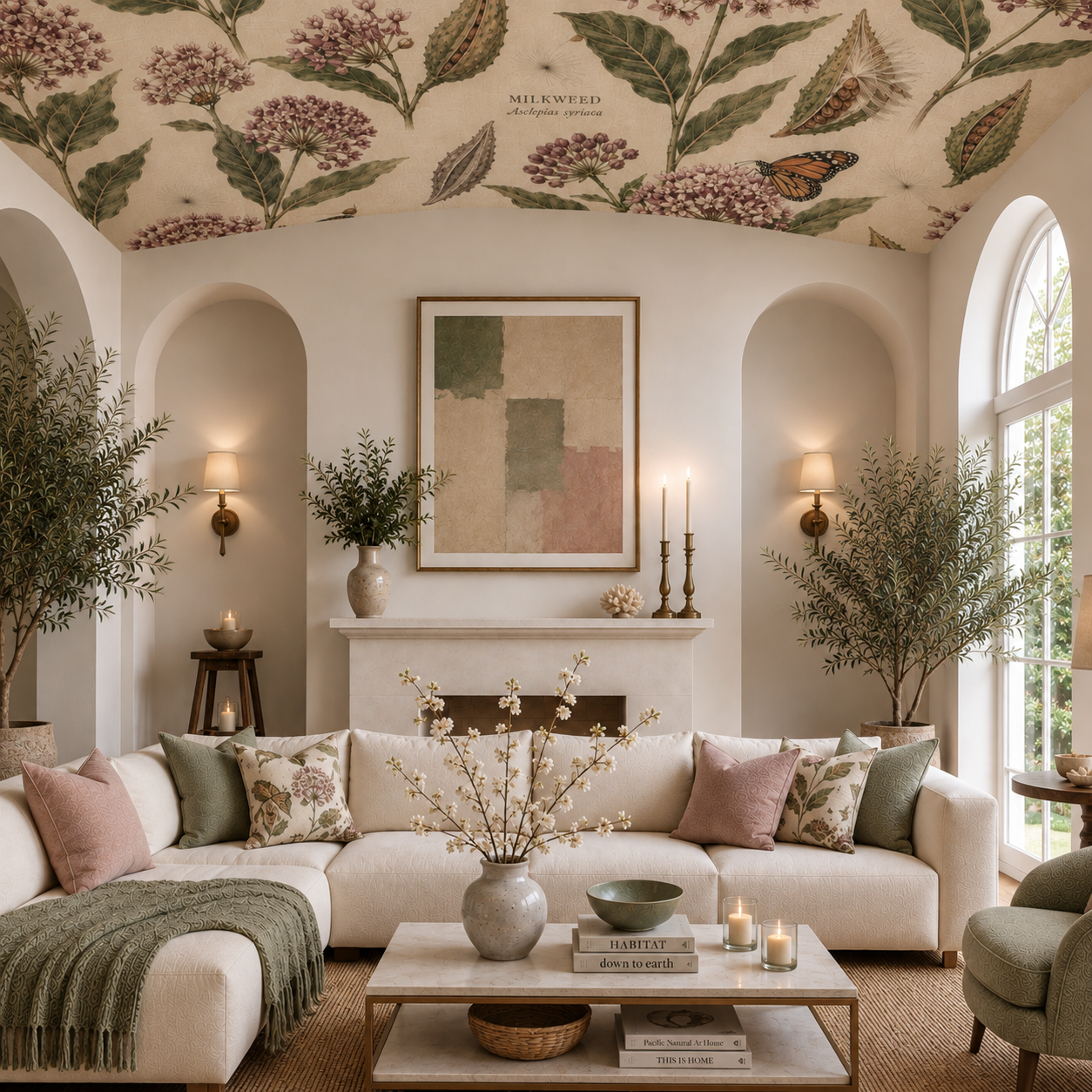
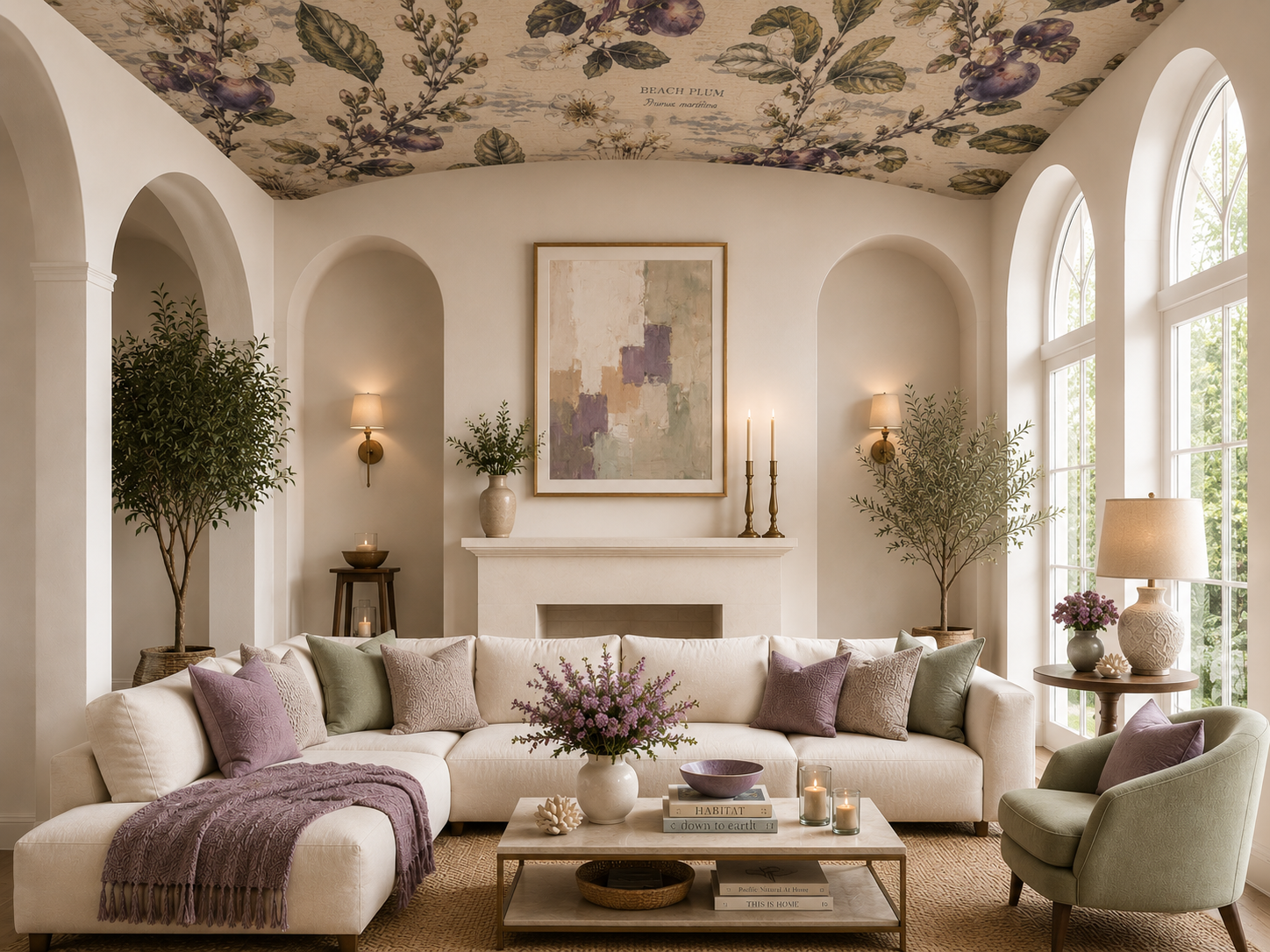
That was part of the thinking behind two recent Ready to ReHo™ Design studies: Milkweed and Beach Plum, both imagined as statement ceiling treatments.
With Milkweed, the botanical imagery stretches overhead in a softly colored living space, creating the feeling of being beneath a canopy of coastal plant life. Beach Plum offers a similar opportunity: a familiar native shoreline plant becomes an architectural detail rather than simply a decorative motif.
The effect can be surprisingly panoramic.
You see the furnishings at eye level, perhaps the garden or landscape through a window, and then another layer of nature overhead. The ceiling becomes part of a kind of 180- or 360-degree visual experience rather than merely the top boundary of the room.
Why designers are looking up
Wallpaper itself is continuing to evolve beyond the traditional accent wall. ELLE Decor's 2026 wallpaper coverage points to designers becoming increasingly intentional about wallcoverings as statement-making elements within a room.
Houzz has also documented growing interest specifically in ceiling wallpaper. In earlier search-trend data, searches for “ceiling wallpaper” rose 40% year over year, while designers described wallpaper as a way to create distinct “moments” throughout a home.
That idea of creating a moment is important.
A ceiling treatment doesn't necessarily need to cover every room in a house. In fact, its power often comes from restraint.
A powder room, bedroom, dining room, sunroom, entry, home office or intimate sitting room can become an ideal place to experiment. Houzz designers have noted that ceilings can be particularly useful when walls are already dominated by windows or cabinetry, and that applying pattern overhead can create significant visual impact without covering all four walls.
Think of the ceiling as atmosphere
The most successful ceiling treatments, in my view, are not simply decorative.
They change how a room feels.
A botanical can soften a space. A darker pattern can make a room feel intimate and cocooning. A light ground can keep the room airy while still introducing detail. A reflective or textured wallcovering can catch natural light differently throughout the day.
Houzz's earlier “fifth wall” reporting described wallpapered ceilings as capable of making rooms feel cozy and enveloping, while designers used everything from clouds to geometrics and natural imagery to create environments that feel transporting rather than merely decorated.
For a coastal home, that offers an opportunity to think beyond the conventional beach-house vocabulary.
Instead of asking, What should I hang on the wall?
Try asking:
What would I love to look up and see?
Maybe it's wildflowers.
Maybe it's migrating butterflies.
Maybe it's marsh birds, trailing vines or something inspired by the plants growing just outside the window.
The ceiling has been there all along.
We may simply be getting better at noticing it.
Explore the Ready to ReHo™ Design collection, including Milkweed and Beach Plum ceiling applications:
Ready to ReHo™ Design