
A selected story from Coast & Culture Magazine. Preview the cover and pages 3–8 below.
Design · Ecology · Community
Why DesignersAre Looking Up
Botanical wallcoverings bring a new perspective to the “fifth wall,” turning the ceiling into an immersive part of the room.
By Corey Andrew Powell · Issue 01

Your complimentaryissue awaits.
Beyond Pastels: Reimagining the Coastal Home After Dark
How the Nocturne Coast Collection challenges the expected look of seaside interiors
By Corey Andrew Powell
For years, “coastal design” has often arrived with a familiar visual script: pale blues, sandy beige, driftwood neutrals, seashell motifs, and rooms washed in sunny, easy light.
It is a look many people love — and for good reason.
But the coast has never belonged to daylight alone.
At Ready to ReHo™, the Nocturne Coast Collection began with a simple but exciting question: What happens when we design for the coast after dark?
What happens when the inspiration is not only sun and surf, but moonlight on the marsh, glimmers on black water, silhouettes of shoreline grasses, the hush of evening wildlife, and the mysterious beauty that settles over the landscape once the day is done?
The answer has been both visually rich and creatively liberating.
The Coast Has a Nighttime Palette, Too
Creating these rooms has challenged some of our own traditional perspectives about what it means to design for a coastal home.
Coastal interiors can be dramatic, layered, moody, and sophisticated without losing their sense of place. In fact, a darker palette can bring the natural icons of the Delaware coast into even sharper focus.
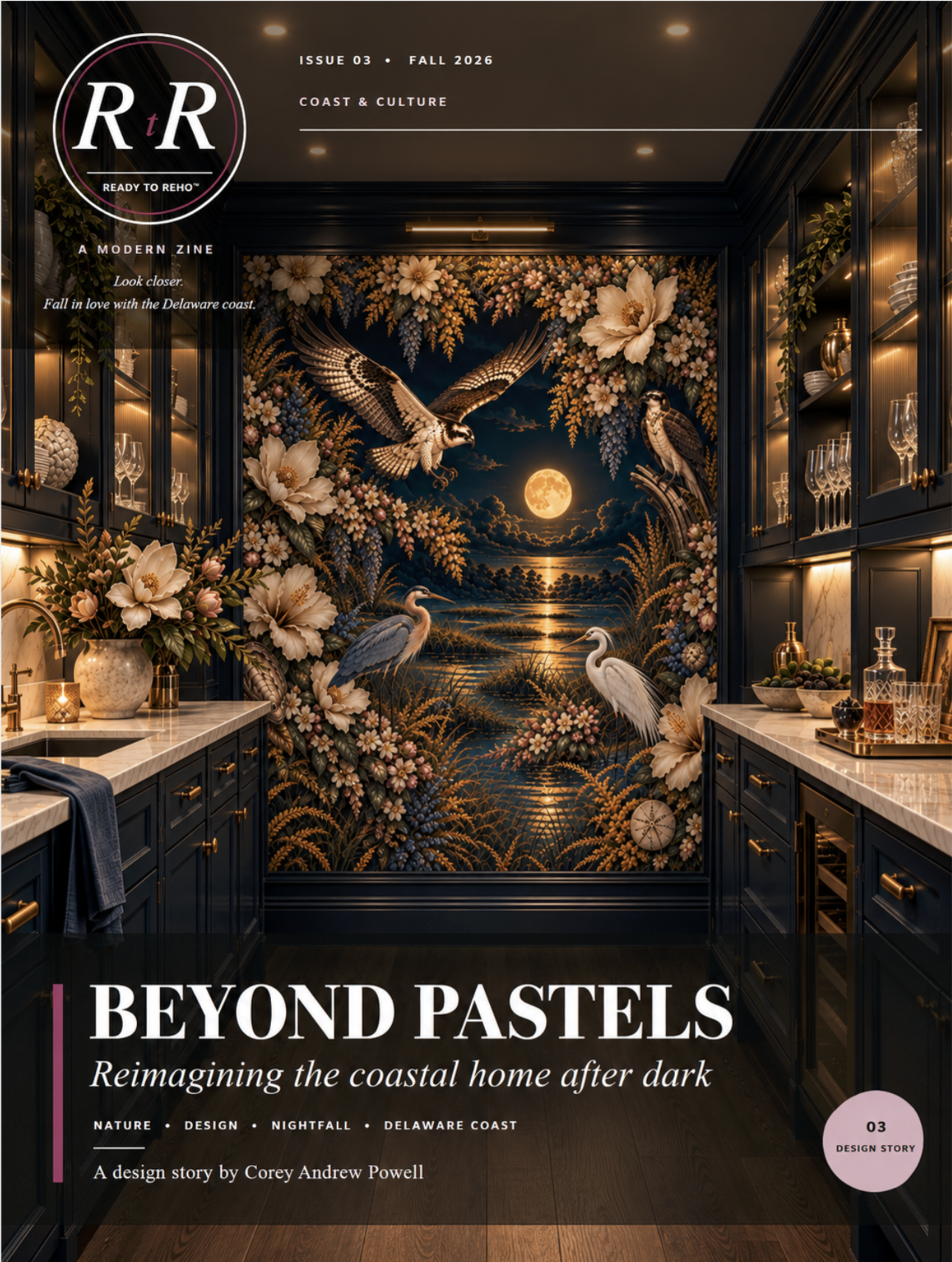
In Aviary Marsh Nocturne, white egrets appear luminous against a dark marshy backdrop, their elegance heightened by glints of reflected moonlight and golden reeds.
It is a coastal story — just not the expected one.
The marsh becomes cinematic, almost magical, while familiar Delaware wildlife takes on a new presence. Egrets, great blue herons, osprey, dragonflies, marsh grasses, and other elements of the coastal ecosystem become more than decorative motifs. They become characters within the room.
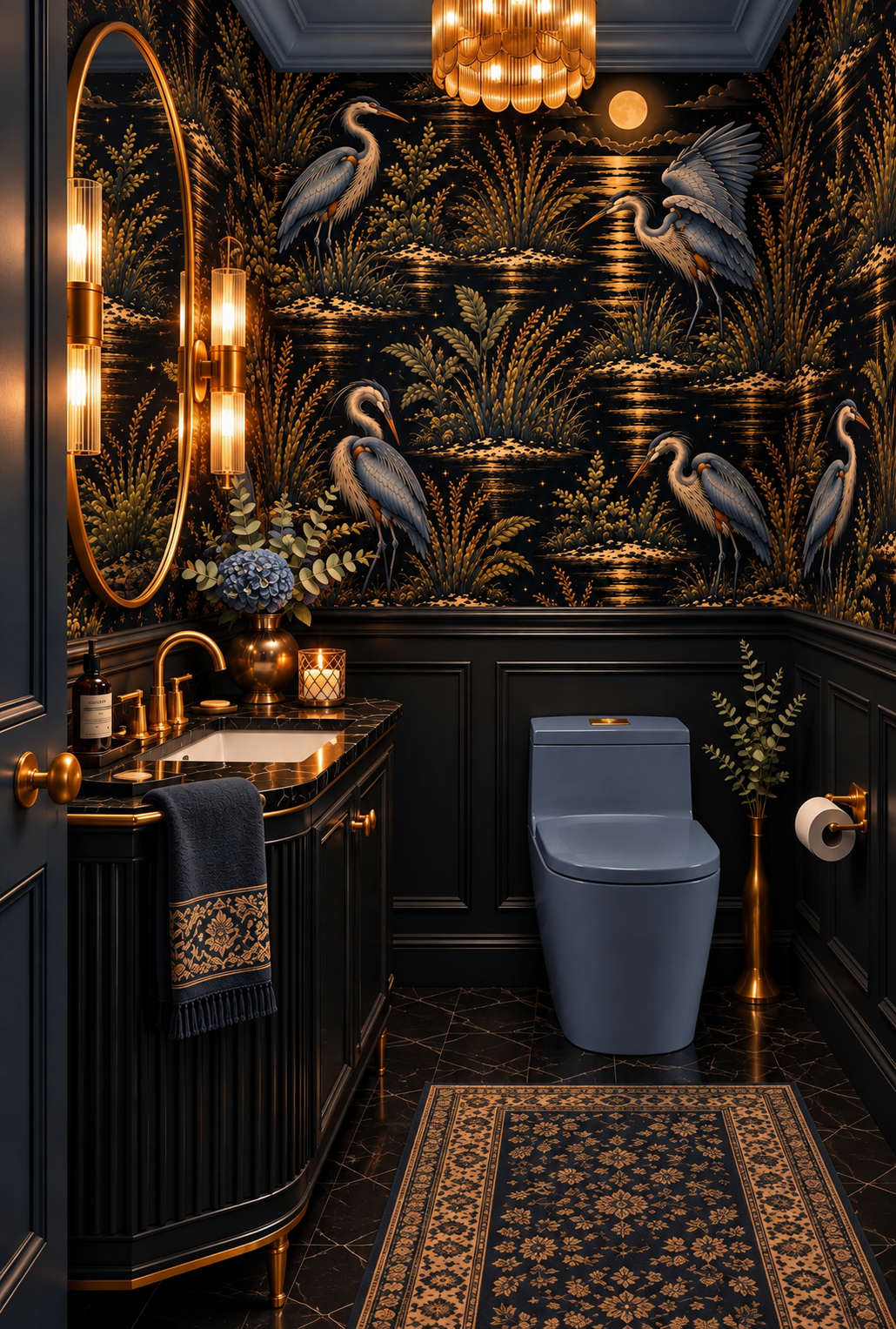
Coastal, Without the Cliché
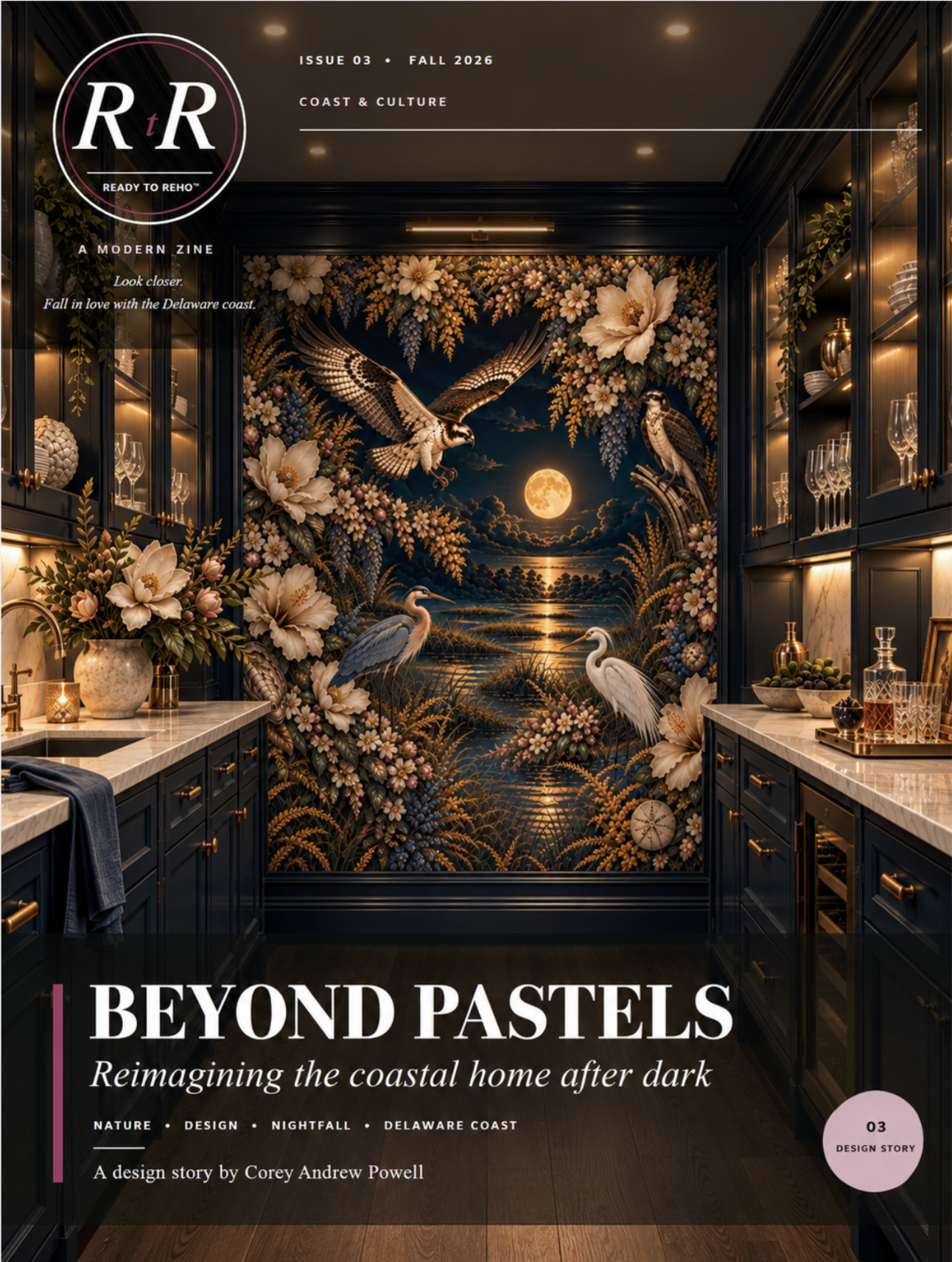
That same idea continues in the Golden Egrets Nocturne kitchen and butler’s pantry.
Black cabinetry, warm metallic accents, dramatic stone, and richly illuminated wildlife show that a coastal interior can feel tailored and luxurious rather than simply breezy.
The connection to the coast is still unmistakable, but it comes through ecology, atmosphere, and place instead of conventional beach-house shorthand.
There doesn’t have to be a seashell on every table.
Midnight Marsh
The Midnight Marsh cabinetry concepts take the idea beyond wallcoverings.
Dragonflies hover over moonlit wetlands. Marsh grasses move through the darkness. Warm interior lighting transforms functional storage into something more atmospheric.
It is an exploration of what can happen when coastal storytelling moves onto furniture and objects within the home.
Rather than treating coastal inspiration as quaint or casual, these pieces imagine it as something sophisticated, immersive, and deeply connected to the natural landscape.
The Magic of the Dragonfly
The Dragonfly Nocturne powder room brings another familiar Delaware icon into focus.
Dragonflies have always fascinated me. Around wetlands and coastal landscapes, they seem to appear as flashes of color and movement — their wings catching light for only a moment before they disappear again.
Against a dark background, that quality becomes even more pronounced.
Marsh botanicals, water, reeds, and small points of glowing light turn a compact powder room into an immersive nighttime landscape.
And perhaps that is one of the pleasures of designing smaller spaces: they give us permission to be dramatic.
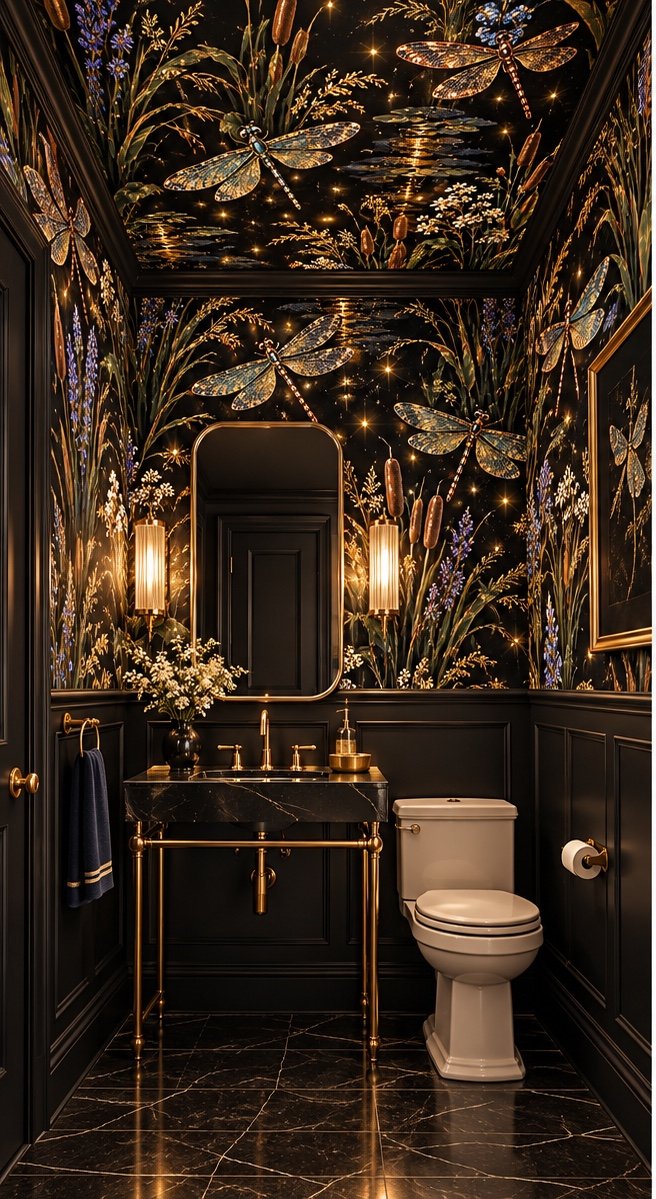
A Richer View of the Coast
The Nocturne Coast Collection is rooted in a simple idea: coastal interiors can be atmospheric as well as airy.
The coast contains romance, wildness, darkness, softness, glamour, and surprise.
Designing for it does not require choosing between authenticity and drama.
Sometimes the most interesting way to honor a place is to look beyond its most familiar image.
Because the coast does not disappear when the sun goes down.
In many ways, that is when it becomes most mysterious.
Explore More
Discover more original wallcoverings, textiles, interiors, and design concepts from Threads of the Delaware Coast™and Ready to ReHo™.
Slow Down. Look Closer. Fall in Love with the Delaware Coast.
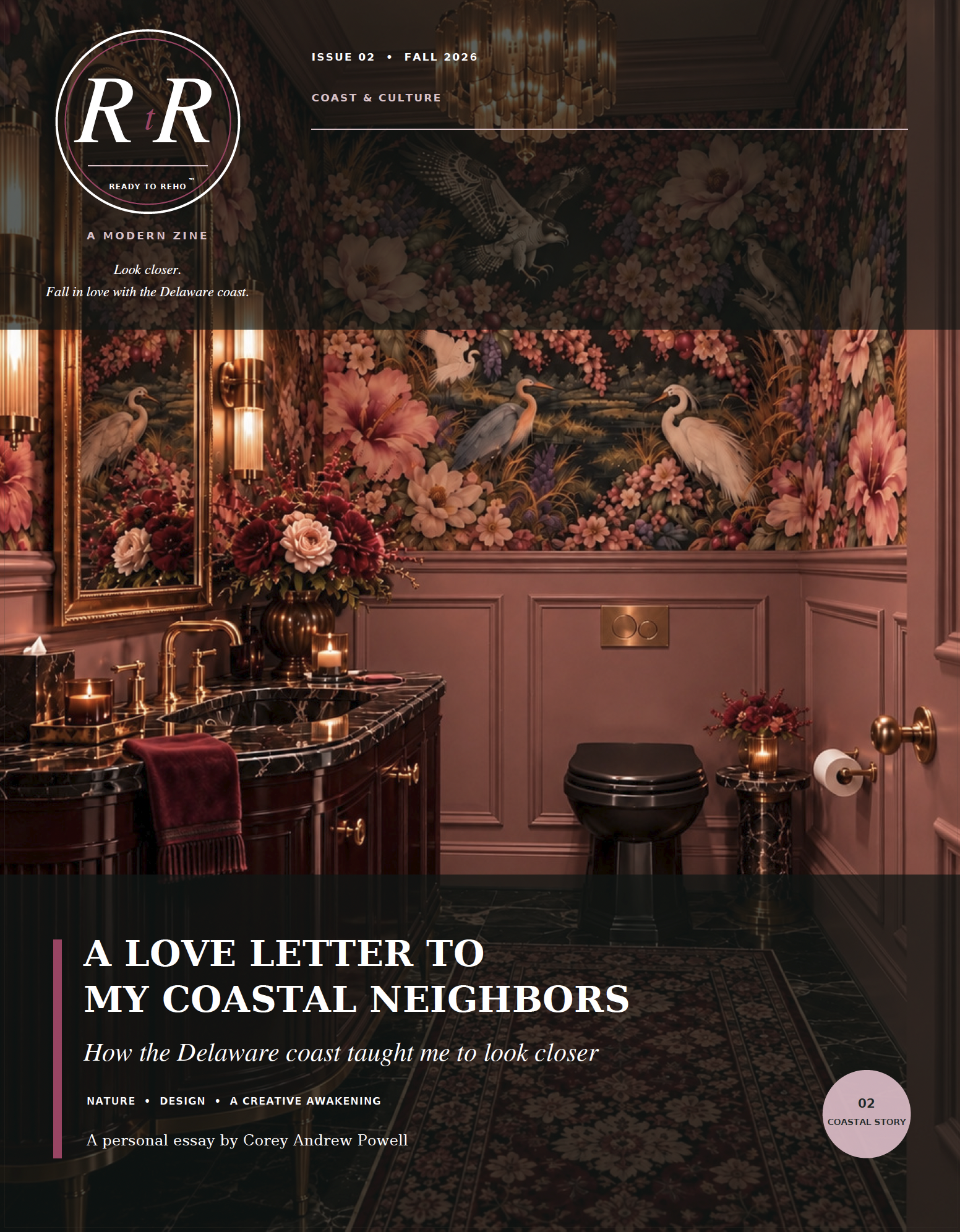
A Love Letter to My Coastal Neighbors
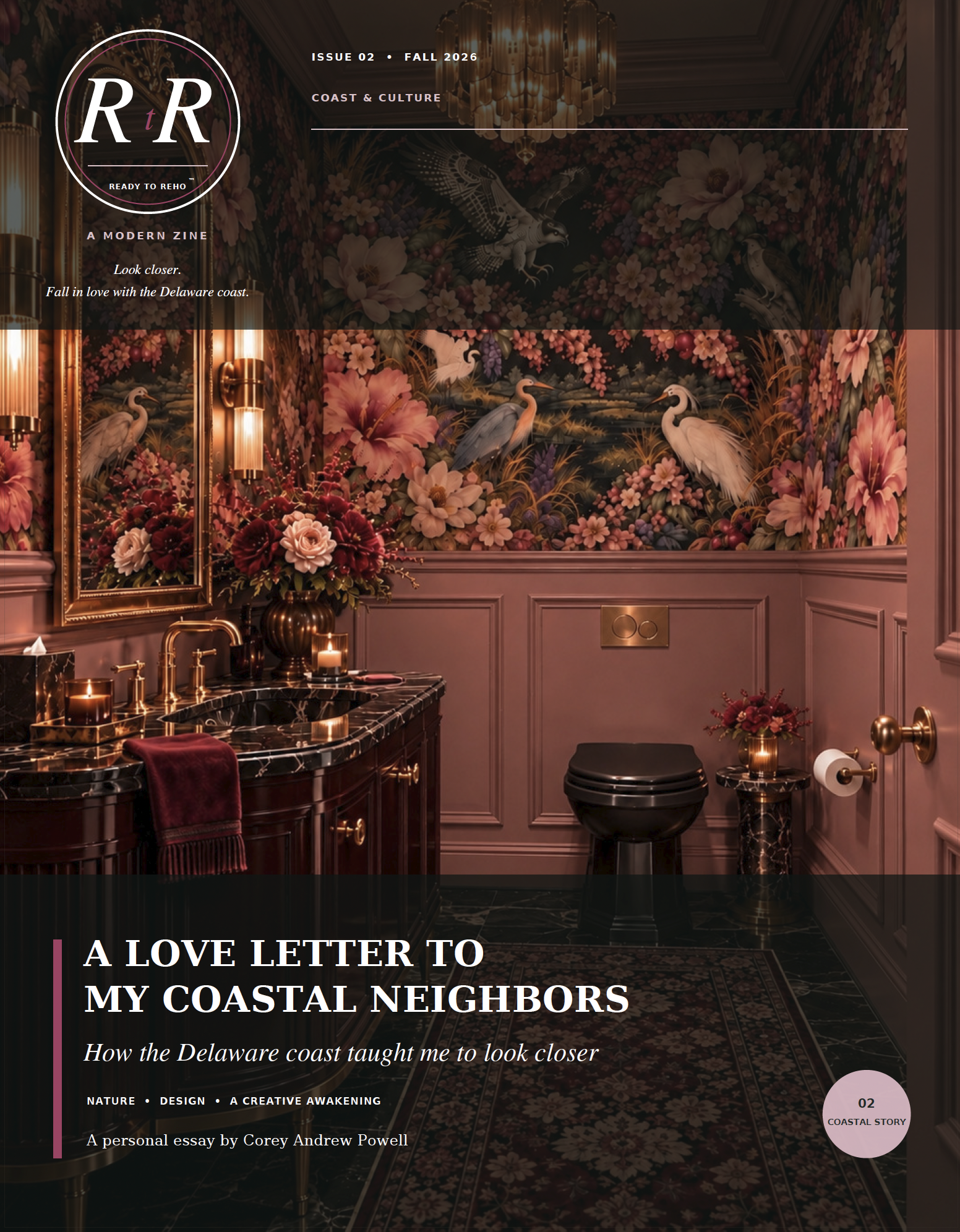
How foxes, herons, skinks — and one remarkably fortunate spider — taught a lifelong suburbanite and city dweller to slow down, look closer and fall in love with the Delaware coast.
By Corey Andrew Powell
I may be one of the least likely people to have fallen so completely in love with the wildlife of coastal Delaware.
I was raised mostly in the suburbs, but I spent nearly half my life living in New York City. Nature was something I appreciated in theory. I liked beautiful landscapes, ocean views and a well-maintained park as much as anyone. But insects, reptiles and other creatures with more legs than I have? We were not necessarily on speaking terms.
Dragonflies were always the exception. Somehow, they never counted.
Then, in 2022, I became a homeowner near the Delaware coast — and almost immediately, everything began to change.
My backyard sits beside a preserved natural area. What initially seemed like a beautiful green backdrop gradually revealed itself as an entire living community. Before long, I began meeting the residents.
A living community reveals itself
There were red foxes slipping quietly through the landscape, sometimes stopping long enough for me to feel as though they were allowing me an audience. Families of white-tailed deer appeared without warning: mothers, young deer and the occasional buck moving through the trees as naturally as neighbors crossing from one yard to another.
There were rabbits so enormous that, from a distance, they sometimes appeared to be the size of small dogs. After a rainstorm, frogs would materialize on the patio. Great blue herons and egrets — two of my favorite birds — became part of the everyday view, flying overhead or moving through the surrounding wetlands with a kind of prehistoric elegance.
These were no longer animals I encountered in documentaries or admired in photographs. They were living beside me.
They had become my coastal neighbors — the inspiration for what would eventually become Meet Your Coastal Neighbors™.
Fear gives way to fascination
Not every introduction was immediately welcome.
The five-lined skinks took some getting used to. Their sudden movements could send me in the opposite direction, particularly when one appeared unexpectedly near the house. Lizards had never been among the creatures I was eager to know more intimately.
But something surprising happened over time: I stopped being afraid of them. Then I stopped merely tolerating them. Eventually, I began looking forward to seeing them.
I learned to recognize their brilliant blue tails and the quick flash of movement that announced their arrival. They became another small sign that the landscape around my home was active, healthy and alive.
Spiders remain a more complicated relationship. I would not say we have become friends. We have, however, reached a certain understanding.
Not long ago, an alarmingly large spider found its way into my house. Years earlier, my first instinct might have been to step on it — or at least to summon someone else to step on it.
This time, my immediate thought was different: I needed to get it safely back outside.
Armed with a container, a great deal of determination and only a moderate amount of panic, I managed to cover it, contain it and return it to the outdoors where it belonged. I cannot pretend the experience was entirely serene. But the fact that my first instinct was to preserve its life rather than end it told me something important.
Living so closely with nature had changed me.
An unlikely truce
Perhaps the clearest evidence of this transformation arrived one summer afternoon while I was sitting on my patio.
About 25 feet away, a small black garden snake began slithering across the yard. Once upon a time, this would have resulted in an immediate evacuation — mine, not the snake’s.
Instead, I stayed where I was.
The snake continued along its way, minding its own business. For a moment, it seemed to look in my direction as if to say, “Hey.” Then it kept moving.
I did not interrupt its journey, and it did not interrupt my afternoon.
It was a simple encounter, but also a remarkable one for me. I had begun to understand that I was not merely living near nature. I was living within it. The foxes, deer, birds, frogs, skinks, insects and, yes, snakes were not intruding upon my space. We were sharing the same landscape.
The respect had to travel in both directions.
From observation to design
As a creative person, I suppose it was inevitable that these experiences would eventually find their way into my work.
The more closely I observed the Delaware coast, the more I began to recognize its visual language: the sculptural silhouette of a great blue heron; the graceful white shape of an egret against the marsh; the ancient form of a horseshoe crab; the luminous wings of a dragonfly; the red flash of a fox moving through the trees.
Even the plants I might once have overlooked began to reveal their character. Milkweed, beach plum, bayberry, sea oats and pickerelweed were no longer simply part of the scenery. Each carried its own shape, rhythm, history and ecological purpose.
I began to understand that the quieter beauty of coastal Delaware was not actually quiet at all. It was layered with movement, color, relationships and stories. I simply had to learn how to see it.
Those discoveries became the creative catalyst for my unexpected entrance into the world of textiles and interior design. The creatures and botanicals living around me began to evolve into the icons at the heart of Threads of the Delaware Coast™ — artwork envisioned for wallcoverings, floor coverings, textiles, bedding and objects for the home.
The collection is not simply inspired by coastal aesthetics. It is rooted in particular encounters: the heron that flies past on an ordinary morning, the fox that pauses at the edge of the yard, the frog that appears after a storm and the skink I once feared but now welcome.
Each design begins with a neighbor.
Delaware taught me how to travel differently.
This way of seeing followed me far beyond Delaware.
When my partner Joseph and I recently traveled to Italy, it was my first time there. We experienced Milan, Bologna, Florence, Tuscany, Rome and Sardinia — places overflowing with beauty, history and regional character.
In another season of my life, I might have concentrated almost entirely on the grand attractions: the architecture, the art, the food, the celebrated views. I certainly appreciated all of those things. But coastal Delaware had taught me to look beyond the obvious.
It had taught me to slow down.
So I paid closer attention to the surrounding ecology: the changing vegetation, the regional colors, the coastal light and the relationship between the landscape and the way people live within it. I noticed details I might once have passed without a second thought.
Those observations have already inspired new creative ideas and endeavors that I am not quite ready to reveal — but that I am incredibly excited about.
In an unexpected way, Delaware taught me how to experience Italy more deeply.
The natural world did not suddenly change. I did.
Living near the Delaware coast has made me a more observant person and, I believe, a more thoughtful creative artist. It has taught me that inspiration does not always arrive with a dramatic announcement. Sometimes it moves silently through the backyard. Sometimes it lands on a branch, appears on the patio after the rain or slithers politely past without causing any trouble.
And sometimes it is hiding inside the very thing that once made us uncomfortable.
The natural world did not suddenly change when I moved to Delaware. I did.
I became willing to stop, pay attention and consider the possibility that these creatures were not inconveniences or interruptions. They were part of the character of the place I had chosen to call home.
That is the invitation I now extend to everyone, wherever you happen to live: pay attention to your environment. Notice what grows there. Learn what flies overhead, wanders through the trees or emerges after the rain. Give the overlooked things a second glance.
Slow down. Look closer.
Because the world around us is often so much more extraordinary than what we think we see.

The “Fifth Wall” Is Ready for Its Close-Up
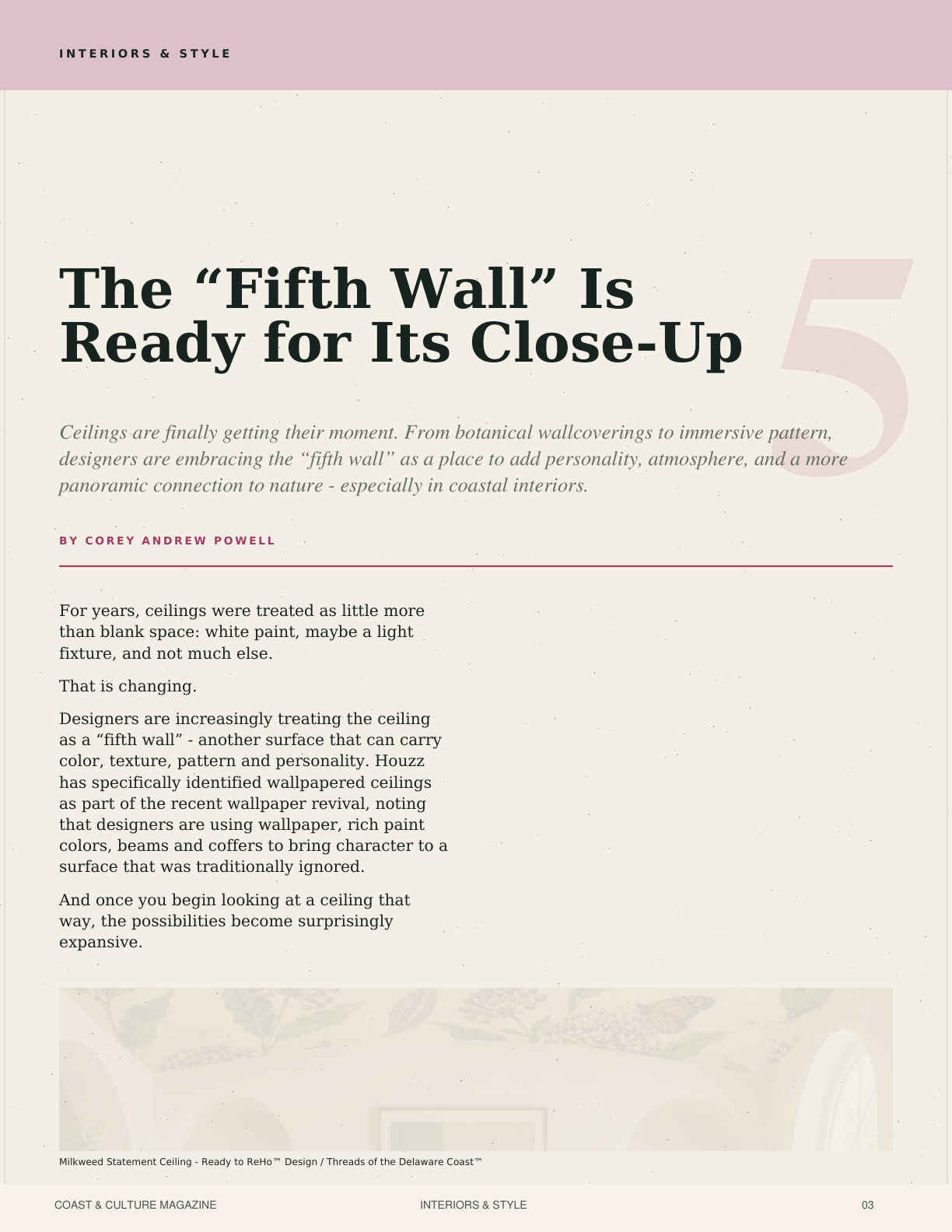
Ceilings are finally getting their moment. From botanical wallcoverings to immersive pattern, designers are embracing the “fifth wall” as a place to add personality, atmosphere, and a more panoramic connection to nature—especially in coastal interiors.

Coastal Living Room featuring the Ready to ReHo Milkweed Ceiling -Wallcovering
For years, ceilings were treated as little more than blank space: white paint, maybe a light fixture, and not much else.
That is changing.
Designers are increasingly treating the ceiling as a “fifth wall”—another surface that can carry color, texture, pattern and personality. Houzz has specifically identified wallpapered ceilings as part of the recent wallpaper revival, noting that designers are using wallpaper, rich paint colors, beams and coffers to bring character to a surface that was traditionally ignored.
And once you begin looking at a ceiling that way, the possibilities become surprisingly expansive.
Bringing the room full circle
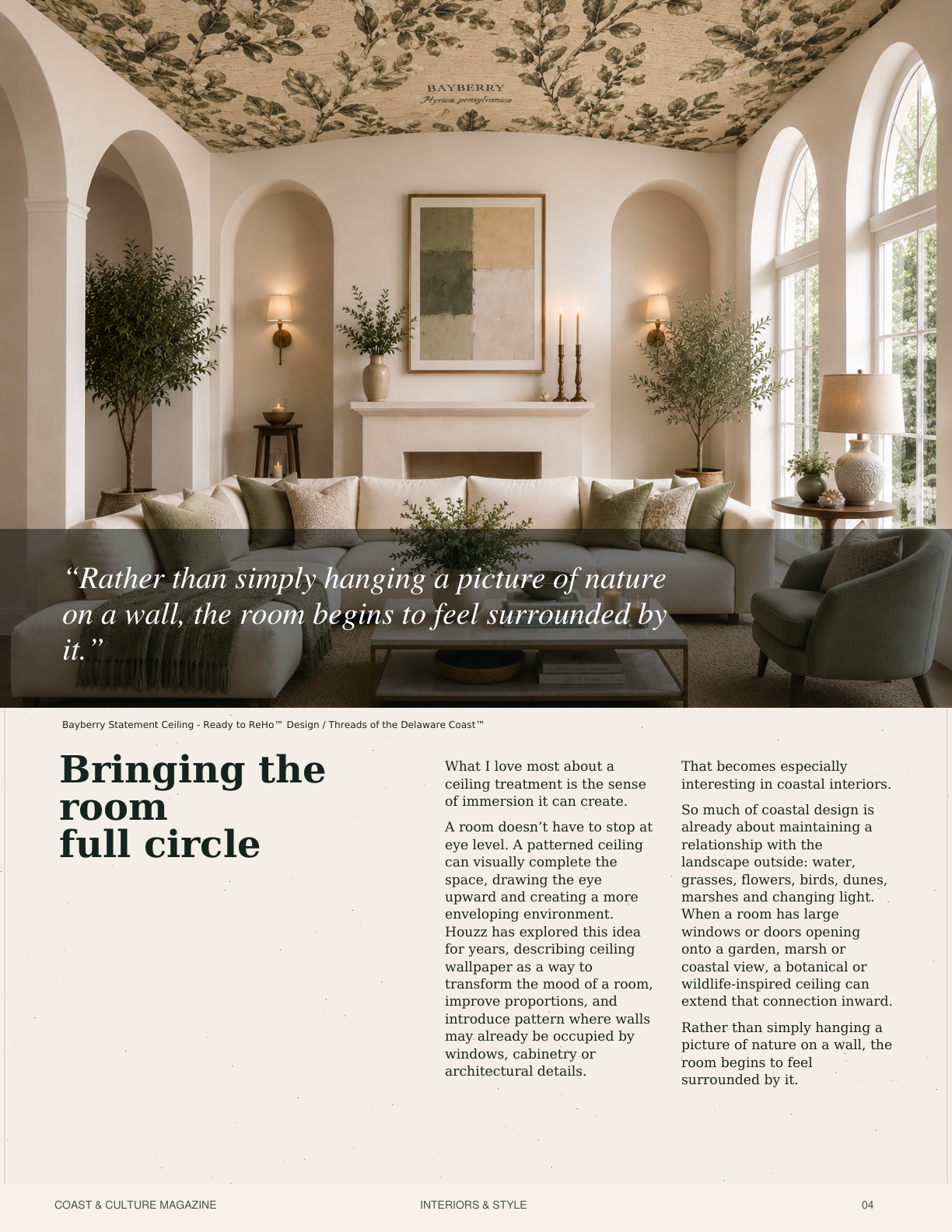
What I love most about a ceiling treatment is the sense of immersion it can create.
A room doesn’t have to stop at eye level. A patterned ceiling can visually complete the space, drawing the eye upward and creating a more enveloping environment. Houzz has explored this idea for years, describing ceiling wallpaper as a way to transform the mood of a room, improve proportions, and introduce pattern where walls may already be occupied by windows, cabinetry or architectural details.
That becomes especially interesting in coastal interiors.
So much of coastal design is already about maintaining a relationship with the landscape outside: water, grasses, flowers, birds, dunes, marshes and changing light. When a room has large windows or doors opening onto a garden, marsh or coastal view, a botanical or wildlife-inspired ceiling can extend that connection inward.
Rather than simply hanging a picture of nature on a wall, the room begins to feel surrounded by it.
A different kind of coastal design
Coastal interiors can easily fall into familiar shorthand—blue-and-white stripes, anchors, shells and obvious beach motifs.
There is nothing wrong with those things. But there are subtler ways to evoke a place.
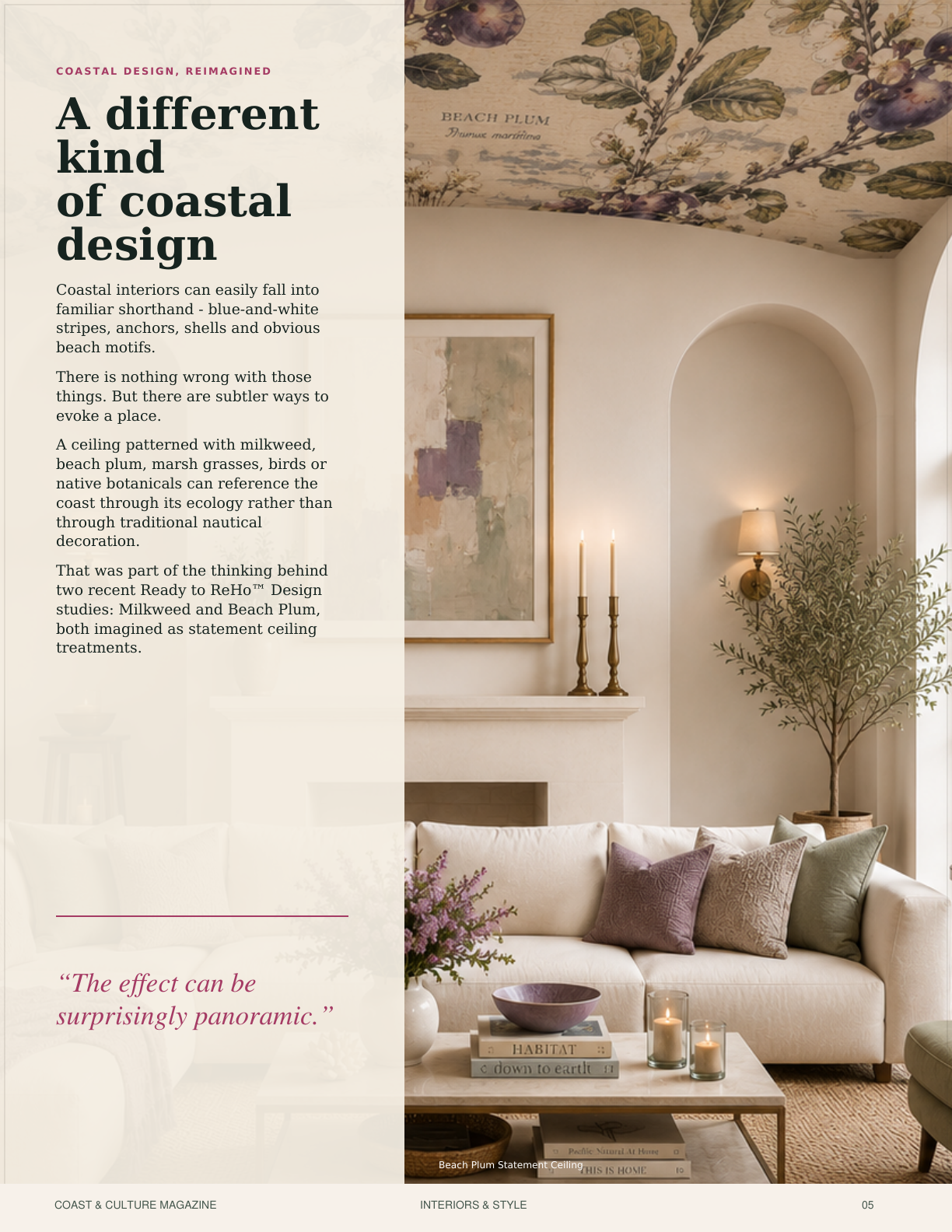
A ceiling patterned with milkweed, beach plum, marsh grasses, birds or native botanicals can reference the coast through its ecology rather than through traditional nautical decoration.
That was part of the thinking behind two recent Ready to ReHo™ Design studies: Milkweed and Beach Plum, both imagined as statement ceiling treatments.
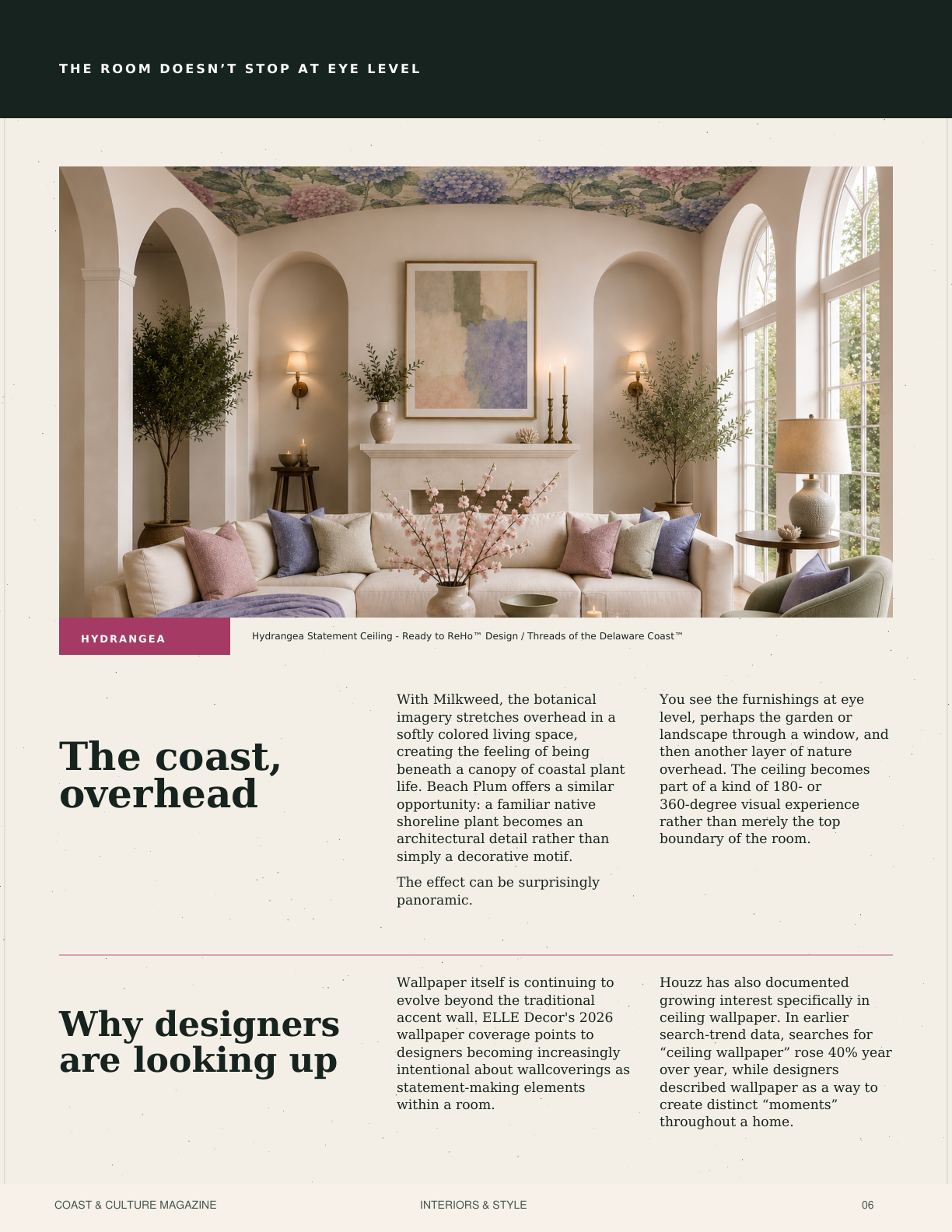
With Milkweed, the botanical imagery stretches overhead in a softly colored living space, creating the feeling of being beneath a canopy of coastal plant life. Beach Plum offers a similar opportunity: a familiar native shoreline plant becomes an architectural detail rather than simply a decorative motif.
The effect can be surprisingly panoramic.
You see the furnishings at eye level, perhaps the garden or landscape through a window, and then another layer of nature overhead. The ceiling becomes part of a kind of 180- or 360-degree visual experience rather than merely the top boundary of the room.
Why designers are looking up
Wallpaper itself is continuing to evolve beyond the traditional accent wall. ELLE Decor's 2026 wallpaper coverage points to designers becoming increasingly intentional about wallcoverings as statement-making elements within a room.
Houzz has also documented growing interest specifically in ceiling wallpaper. In earlier search-trend data, searches for “ceiling wallpaper” rose 40% year over year, while designers described wallpaper as a way to create distinct “moments” throughout a home.
That idea of creating a moment is important.
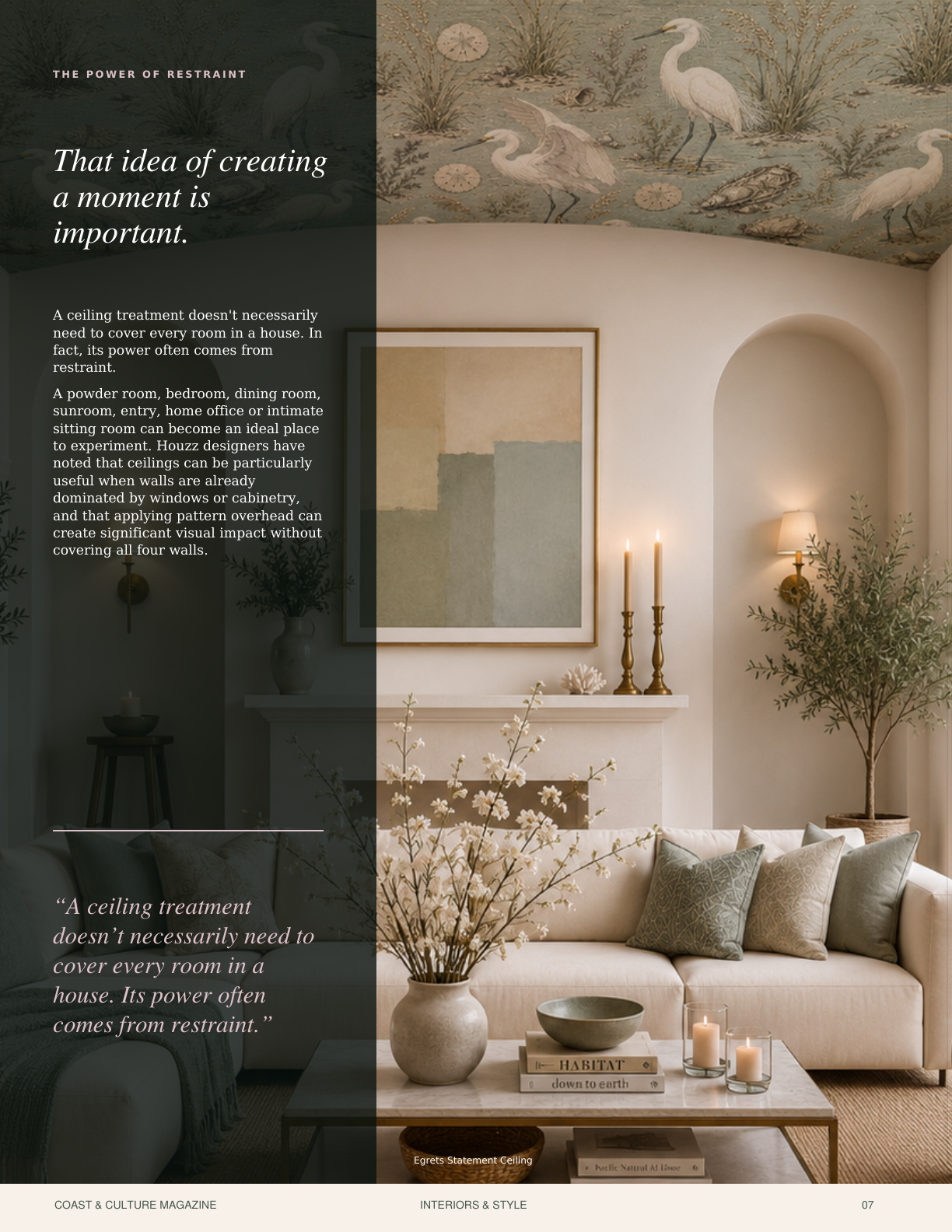
A ceiling treatment doesn't necessarily need to cover every room in a house. In fact, its power often comes from restraint.
A powder room, bedroom, dining room, sunroom, entry, home office or intimate sitting room can become an ideal place to experiment. Houzz designers have noted that ceilings can be particularly useful when walls are already dominated by windows or cabinetry, and that applying pattern overhead can create significant visual impact without covering all four walls.
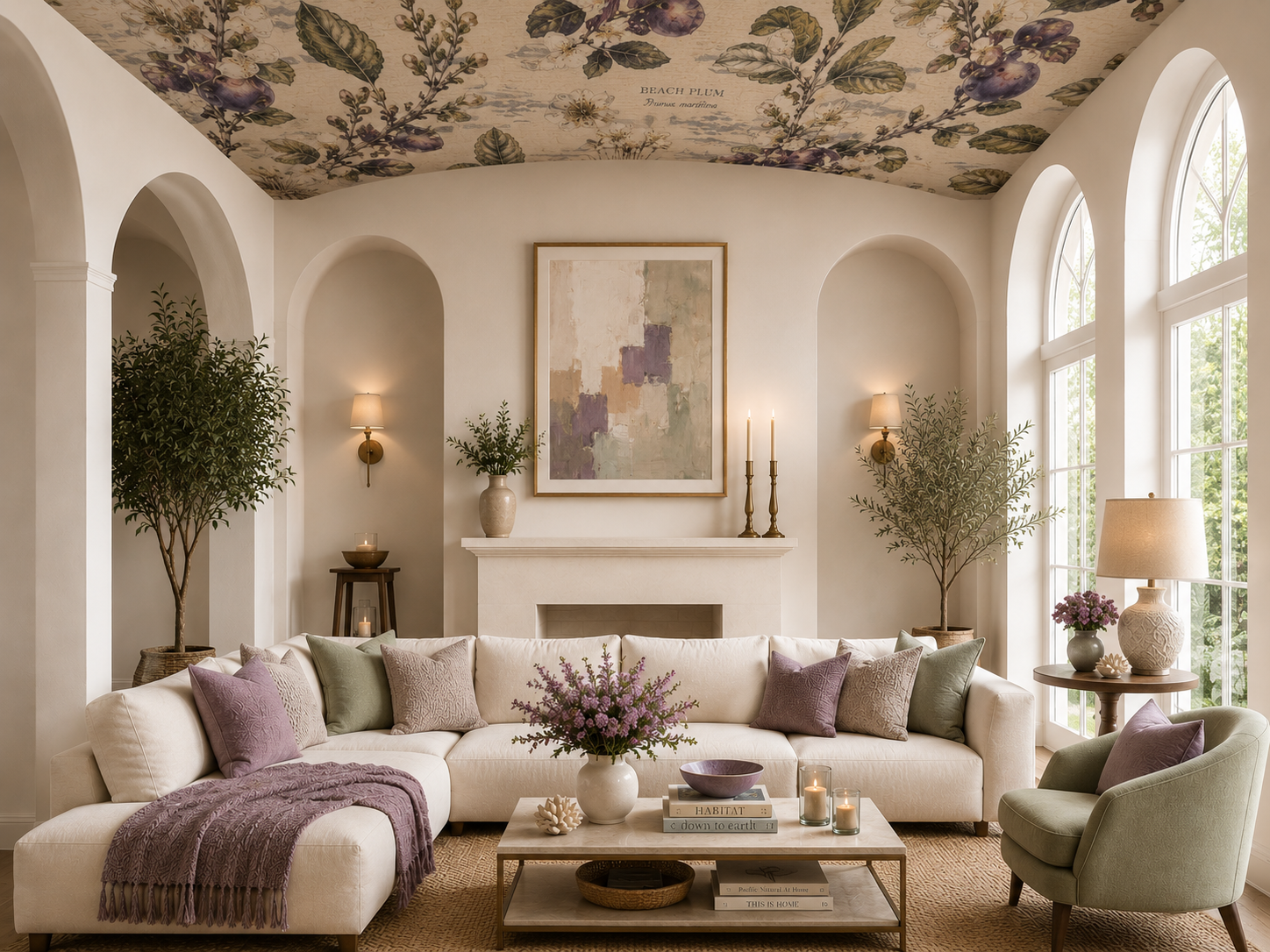
Beach Plum Statement Ceiling — Ready to ReHo™ Design / Threads of the Delaware Coast™
Think of the ceiling as atmosphere
The most successful ceiling treatments, in my view, are not simply decorative.
They change how a room feels.
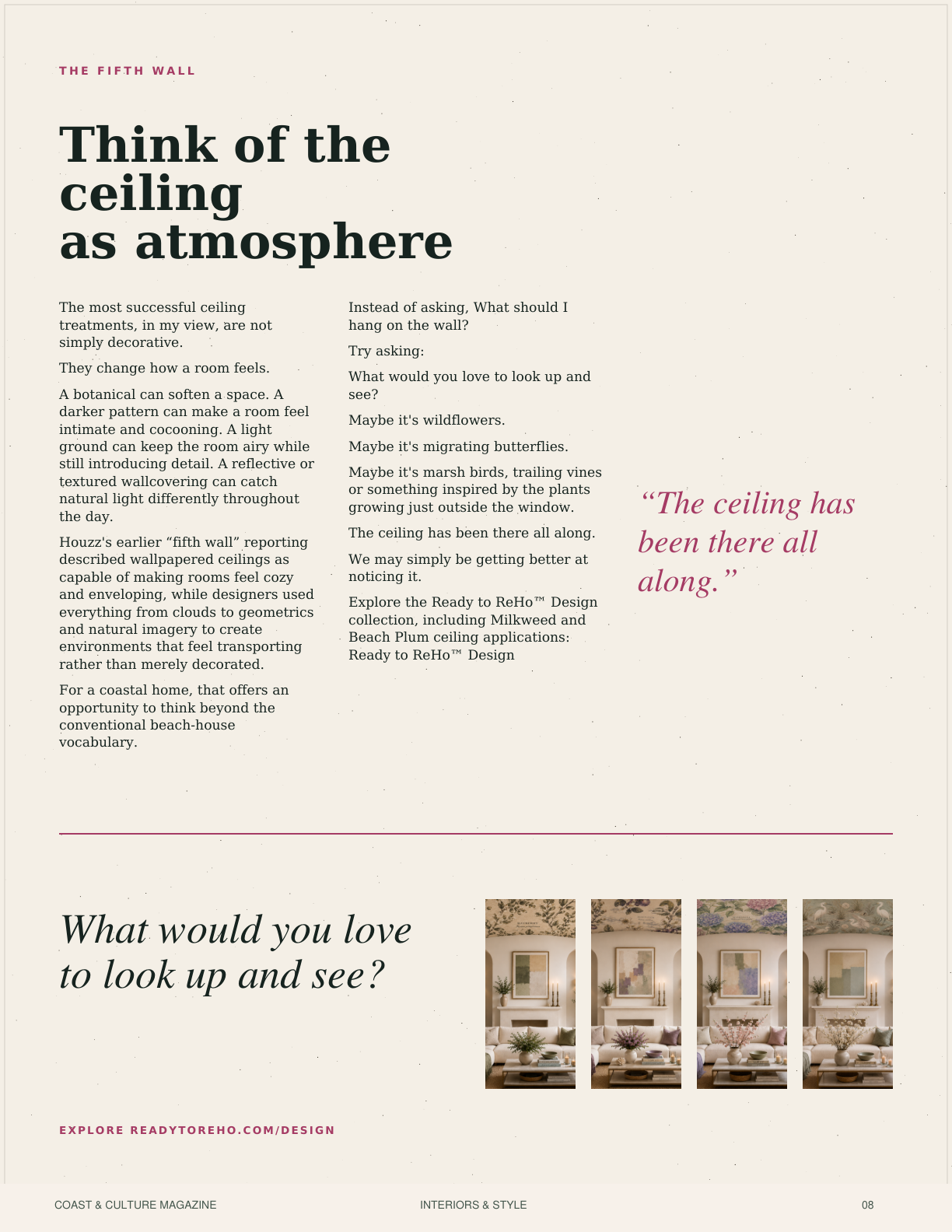
A botanical can soften a space. A darker pattern can make a room feel intimate and cocooning. A light ground can keep the room airy while still introducing detail. A reflective or textured wallcovering can catch natural light differently throughout the day.
Houzz's earlier “fifth wall” reporting described wallpapered ceilings as capable of making rooms feel cozy and enveloping, while designers used everything from clouds to geometrics and natural imagery to create environments that feel transporting rather than merely decorated.
For a coastal home, that offers an opportunity to think beyond the conventional beach-house vocabulary.
Instead of asking, What should I hang on the wall?
Try asking:
What would I love to look up and see?
Maybe it's wildflowers.
Maybe it's migrating butterflies.
Maybe it's marsh birds, trailing vines or something inspired by the plants growing just outside the window.
The ceiling has been there all along.
We may simply be getting better at noticing it.
Explore the Ready to ReHo™ Design collection, including Milkweed and Beach Plum ceiling applications:
Ready to ReHo™ Design