A Love Letter to My Coastal Neighbors
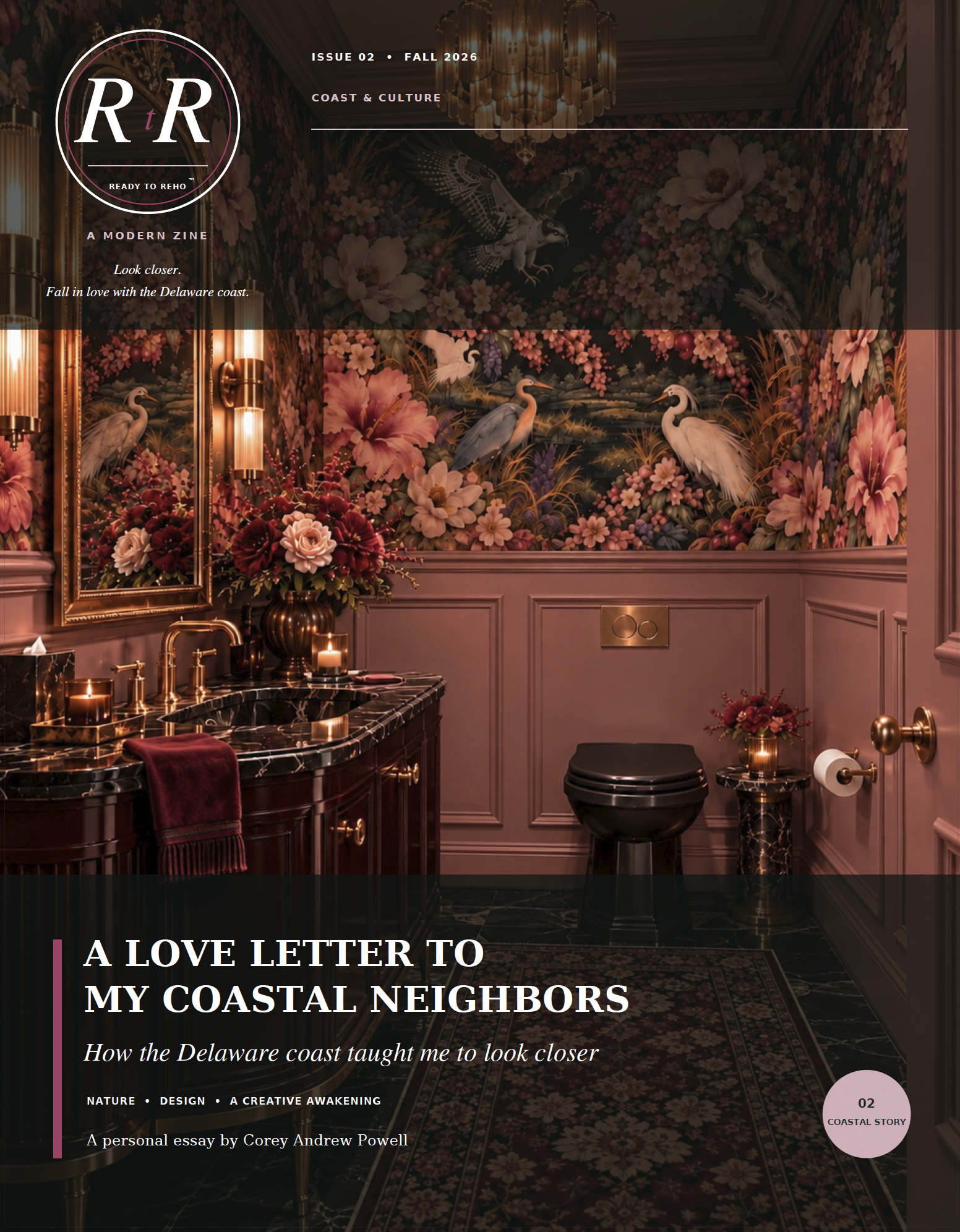
How foxes, herons, skinks — and one remarkably fortunate spider — taught a lifelong suburbanite and city dweller to slow down, look closer and fall in love with the Delaware coast.
By Corey Andrew Powell
I may be one of the least likely people to have fallen so completely in love with the wildlife of coastal Delaware.
I was raised mostly in the suburbs, but I spent nearly half my life living in New York City. Nature was something I appreciated in theory. I liked beautiful landscapes, ocean views and a well-maintained park as much as anyone. But insects, reptiles and other creatures with more legs than I have? We were not necessarily on speaking terms.
Dragonflies were always the exception. Somehow, they never counted.
Then, in 2022, I became a homeowner near the Delaware coast — and almost immediately, everything began to change.
My backyard sits beside a preserved natural area. What initially seemed like a beautiful green backdrop gradually revealed itself as an entire living community. Before long, I began meeting the residents.
A living community reveals itself
There were red foxes slipping quietly through the landscape, sometimes stopping long enough for me to feel as though they were allowing me an audience. Families of white-tailed deer appeared without warning: mothers, young deer and the occasional buck moving through the trees as naturally as neighbors crossing from one yard to another.
There were rabbits so enormous that, from a distance, they sometimes appeared to be the size of small dogs. After a rainstorm, frogs would materialize on the patio. Great blue herons and egrets — two of my favorite birds — became part of the everyday view, flying overhead or moving through the surrounding wetlands with a kind of prehistoric elegance.
These were no longer animals I encountered in documentaries or admired in photographs. They were living beside me.
They had become my coastal neighbors — the inspiration for what would eventually become Meet Your Coastal Neighbors™.
Fear gives way to fascination
Not every introduction was immediately welcome.
The five-lined skinks took some getting used to. Their sudden movements could send me in the opposite direction, particularly when one appeared unexpectedly near the house. Lizards had never been among the creatures I was eager to know more intimately.
But something surprising happened over time: I stopped being afraid of them. Then I stopped merely tolerating them. Eventually, I began looking forward to seeing them.
I learned to recognize their brilliant blue tails and the quick flash of movement that announced their arrival. They became another small sign that the landscape around my home was active, healthy and alive.
Spiders remain a more complicated relationship. I would not say we have become friends. We have, however, reached a certain understanding.
Not long ago, an alarmingly large spider found its way into my house. Years earlier, my first instinct might have been to step on it — or at least to summon someone else to step on it.
This time, my immediate thought was different: I needed to get it safely back outside.
Armed with a container, a great deal of determination and only a moderate amount of panic, I managed to cover it, contain it and return it to the outdoors where it belonged. I cannot pretend the experience was entirely serene. But the fact that my first instinct was to preserve its life rather than end it told me something important.
Living so closely with nature had changed me.
An unlikely truce
Perhaps the clearest evidence of this transformation arrived one summer afternoon while I was sitting on my patio.
About 25 feet away, a small black garden snake began slithering across the yard. Once upon a time, this would have resulted in an immediate evacuation — mine, not the snake’s.
Instead, I stayed where I was.
The snake continued along its way, minding its own business. For a moment, it seemed to look in my direction as if to say, “Hey.” Then it kept moving.
I did not interrupt its journey, and it did not interrupt my afternoon.
It was a simple encounter, but also a remarkable one for me. I had begun to understand that I was not merely living near nature. I was living within it. The foxes, deer, birds, frogs, skinks, insects and, yes, snakes were not intruding upon my space. We were sharing the same landscape.
The respect had to travel in both directions.
From observation to design
As a creative person, I suppose it was inevitable that these experiences would eventually find their way into my work.
The more closely I observed the Delaware coast, the more I began to recognize its visual language: the sculptural silhouette of a great blue heron; the graceful white shape of an egret against the marsh; the ancient form of a horseshoe crab; the luminous wings of a dragonfly; the red flash of a fox moving through the trees.
Even the plants I might once have overlooked began to reveal their character. Milkweed, beach plum, bayberry, sea oats and pickerelweed were no longer simply part of the scenery. Each carried its own shape, rhythm, history and ecological purpose.
I began to understand that the quieter beauty of coastal Delaware was not actually quiet at all. It was layered with movement, color, relationships and stories. I simply had to learn how to see it.
Those discoveries became the creative catalyst for my unexpected entrance into the world of textiles and interior design. The creatures and botanicals living around me began to evolve into the icons at the heart of Threads of the Delaware Coast™ — artwork envisioned for wallcoverings, floor coverings, textiles, bedding and objects for the home.
The collection is not simply inspired by coastal aesthetics. It is rooted in particular encounters: the heron that flies past on an ordinary morning, the fox that pauses at the edge of the yard, the frog that appears after a storm and the skink I once feared but now welcome.
Each design begins with a neighbor.
Delaware taught me how to travel differently.
This way of seeing followed me far beyond Delaware.
When my partner Joseph and I recently traveled to Italy, it was my first time there. We experienced Milan, Bologna, Florence, Tuscany, Rome and Sardinia — places overflowing with beauty, history and regional character.
In another season of my life, I might have concentrated almost entirely on the grand attractions: the architecture, the art, the food, the celebrated views. I certainly appreciated all of those things. But coastal Delaware had taught me to look beyond the obvious.
It had taught me to slow down.
So I paid closer attention to the surrounding ecology: the changing vegetation, the regional colors, the coastal light and the relationship between the landscape and the way people live within it. I noticed details I might once have passed without a second thought.
Those observations have already inspired new creative ideas and endeavors that I am not quite ready to reveal — but that I am incredibly excited about.
In an unexpected way, Delaware taught me how to experience Italy more deeply.
The natural world did not suddenly change. I did.
Living near the Delaware coast has made me a more observant person and, I believe, a more thoughtful creative artist. It has taught me that inspiration does not always arrive with a dramatic announcement. Sometimes it moves silently through the backyard. Sometimes it lands on a branch, appears on the patio after the rain or slithers politely past without causing any trouble.
And sometimes it is hiding inside the very thing that once made us uncomfortable.
The natural world did not suddenly change when I moved to Delaware. I did.
I became willing to stop, pay attention and consider the possibility that these creatures were not inconveniences or interruptions. They were part of the character of the place I had chosen to call home.
That is the invitation I now extend to everyone, wherever you happen to live: pay attention to your environment. Notice what grows there. Learn what flies overhead, wanders through the trees or emerges after the rain. Give the overlooked things a second glance.
Slow down. Look closer.
Because the world around us is often so much more extraordinary than what we think we see.